
Roots Blower Selection Guide for the Wastewater Treatment Industry: Pressure, Airflow and Seasonal O
Post time: 2026-09-16 13:50:23
With the continued development of municipal wastewater treatment, industrial wastewater management and environmental infrastructure, the aeration system has attracted increasing attention as a critical component of biological wastewater treatment. As a commonly used air supply device for aeration systems, the Roots blower is widely used in the wastewater treatment industry because of its simple structure, stable operation, continuous air supply and convenient flow adjustment.
For wastewater treatment projects, selecting a Roots blower is not simply a matter of choosing equipment based on rated power or rated airflow. Factors such as aeration tank water depth, pipeline resistance, diffuser performance, actual oxygen demand, seasonal temperature variations and the equipment's operating range must all be considered.
I. Why Roots Blowers Are Widely Used in Wastewater Treatment Aeration Systems
Stable Air Supply Through Positive-Displacement Design
A Roots blower is a positive-displacement rotary gas machine. It uses synchronized gears to drive two lobes rotating at the same speed in opposite directions inside the casing. As the lobes rotate, gas is continuously drawn in and transported toward the discharge side, providing a continuous and forced air supply.
Compared with some other types of blowers, Roots blowers have a relatively simple structure and can maintain a stable volumetric flow rate during operation. This makes them suitable for aeration systems that require continuous air supply.
During biological wastewater treatment, microorganisms need a continuous supply of oxygen. The airflow delivered by the blower directly affects dissolved oxygen levels in the aeration tank, making airflow stability and controllability important factors in equipment selection.
Back Pressure Determines the Actual Operating Pressure
One important characteristic of a Roots blower is that its discharge pressure is not simply a fixed pressure generated by the blower itself. Instead, it is primarily determined by the resistance of the system downstream of the blower, commonly referred to as back pressure.
In wastewater treatment aeration systems, back pressure mainly comes from aeration tank water depth, diffuser resistance, air pipeline resistance and local pressure losses caused by fittings.
Therefore, when selecting a Roots blower, it is not sufficient to consider only the rated pressure shown on the equipment nameplate. The actual resistance of the entire aeration system must also be calculated.
II. How to Determine the Required Airflow for a Wastewater Treatment Roots Blower
Preliminary Airflow Estimation Based on Aeration Area
Airflow is another core parameter in Roots blower selection.
For formal engineering design, blower airflow should not be determined solely according to aeration tank area. Instead, it should be calculated based on biological oxygen demand, including oxygen requirements for organic matter degradation and ammonia nitrification, together with factors such as water temperature, sludge age, influent and effluent water quality, and other process parameters.
During the preliminary project planning stage, when complete biological process parameters may not yet be available, a preliminary estimate can be made based on aeration tank area and diffuser quantity.
For example, assuming approximately four diffusers are installed per square meter, the typical design airflow of fine-bubble diffusers can be preliminarily estimated at approximately 1.5–3 m³/h per diffuser, or about 0.025–0.05 m³/min per diffuser.
It should be emphasized that this calculation is intended only for preliminary planning. Formal equipment selection should be based on the actual diffuser specifications and detailed oxygen demand calculations.
Reasonable Safety Margins Should Be Reserved
After calculating the theoretical oxygen demand and design airflow, consideration should also be given to fluctuations that may occur during actual wastewater treatment plant operation.
In general, a safety margin of approximately 10%–15% may be added to the calculated airflow to accommodate variations in influent loading, equipment performance degradation and changes in operating conditions.
However, the safety margin should not be unnecessarily large. If a blower operates continuously at a significantly higher airflow than actually required, energy may be wasted and excessive dissolved oxygen levels may occur in the aeration tank, increasing operating costs.
III. How Seasonal Variations Affect Roots Blower Operation
Temperature Changes Affect Air Mass Flow
During actual wastewater treatment plant operation, there can be significant differences between winter and summer temperatures, while air density changes with temperature.
For the same Roots blower, volumetric airflow at the same speed and under similar operating conditions does not change to the same extent as air density. However, because air density varies, the mass flow rate of the delivered air changes accordingly.
In winter, lower air temperatures generally result in higher air density. Therefore, the same volume of air corresponds to a greater mass of air. In summer, higher temperatures reduce air density, meaning that the same volumetric airflow corresponds to a lower air mass.
Seasonal Adjustment Becomes an Important Operating Consideration
For wastewater treatment plants, oxygen demand is affected not only by influent loading but also by water temperature, microbial activity and process operating conditions.
If the air supply remains unchanged during winter, the increased air mass flow may cause significant changes in dissolved oxygen levels in the aeration tank. Therefore, operators need to adjust blower operation based on online dissolved oxygen measurements, influent loading and process requirements.
A variable-frequency-drive Roots blower can adjust airflow by changing blower speed, allowing air supply to better match actual oxygen demand under different seasons and operating conditions.
IV. Other Factors to Consider When Selecting a Roots Blower
1. Relationship Between Speed and Airflow
Under normal conditions, Roots blower airflow is approximately proportional to rotational speed, making variable-frequency speed control an effective method of airflow regulation.
However, lower speed is not always better. When the rotational speed is too low, internal leakage may account for a larger proportion of total airflow, resulting in reduced volumetric efficiency. Shaft power also does not continue to decrease in a simple proportional relationship with speed.
Therefore, for a specific Roots blower model, the minimum operating speed should be determined based on the manufacturer's performance curve and allowable variable-frequency operating range. In engineering applications, a common recommendation is to avoid long-term operation below approximately 50% of rated speed, although the final value should be determined according to the technical specifications of the specific model.
2. Proper Motor Power Matching
At a relatively fixed airflow, higher system pressure generally requires greater shaft power from the Roots blower.
Therefore, shaft power should be calculated based on the actual airflow and pressure, and the motor should be properly sized. Motor selection should not be based solely on the blower's rated airflow. The motor must be capable of covering the power requirements under actual operating pressure.
In engineering design, a power reserve of approximately 5%–15% can be considered according to actual operating conditions to reduce the risk of long-term full-load or overload operation.
3. Operating Point Should Be Within the Efficient Range
Blower airflow and pressure are not independent parameters. Together, they define the actual operating point.
During selection, the design airflow and pressure should be plotted against the blower performance curve to determine whether the operating point falls within a reasonable and efficient operating range.
Long-term operation near the edge of the performance curve may result in reduced efficiency, higher energy consumption or insufficient adjustment capability. For wastewater treatment plants that operate continuously over long periods, an appropriate high-efficiency operating range is particularly important.
4. Select Appropriate Materials According to Air Conditions
Roots blowers used in wastewater treatment plants generally transport ambient air. However, under special operating conditions, the air may contain corrosive components, dust or water vapor.
When the air conditions are relatively complex, the materials used for rotors, casings and sealing systems may need to be specially designed. Depending on the actual operating conditions, options such as nickel-phosphorus-plated rotors, PTFE coatings and labyrinth seals may be considered.
The specific material and sealing method should be selected according to the air composition, temperature, humidity and the equipment manufacturer's technical requirements.
5. Noise and Heat Dissipation Should Not Be Overlooked
Roots blowers can generate noticeable mechanical and aerodynamic noise during operation. Actual noise levels depend on factors such as blower model, speed, pressure, noise-control measures and installation environment.
For wastewater treatment projects located near residential areas, offices or other noise-sensitive locations, noise control should be considered during the design stage.
Common measures include inlet silencers, discharge silencers, acoustic enclosures and flexible connectors. At the same time, heat dissipation must be considered when an acoustic enclosure is installed. Adequate ventilation should be provided to prevent excessive temperatures from affecting the long-term operation of the motor and blower.
V. Intelligent Control Promotes Further Aeration Energy Savings
With the wastewater treatment industry moving toward more refined and intelligent operation, traditional constant-airflow operation is gradually being replaced by demand-based air supply.
Through online dissolved oxygen monitoring, variable-frequency control and automatic adjustment systems, blower speed can be adjusted according to the real-time operating condition of the biological treatment tank. In systems with multiple blowers operating in parallel, equipment combinations can also be adjusted according to total airflow demand, reducing unnecessary energy consumption under low-load conditions.
For wastewater treatment plants, the blower system is often a major energy-consuming component of the aeration process. Therefore, properly selecting Roots blowers and combining them with variable-frequency drives and automatic control systems can help improve aeration system stability and energy efficiency.
VI. Scientific Selection Is the Foundation for Stable Wastewater Treatment Operation
Overall, Roots blower selection for the wastewater treatment industry is not simply a matter of determining "airflow + pressure." It requires comprehensive consideration of process requirements, diffuser performance, pipeline resistance, seasonal variations, equipment efficiency and operating adjustment range.
During the preliminary planning stage, airflow can be initially estimated based on aeration area and diffuser quantity. During formal engineering design, detailed oxygen demand calculations, pipeline pressure-loss calculations and blower performance curve matching should be completed. Motor power and the number of operating units should then be determined according to actual operating requirements.
For wastewater treatment projects that operate continuously over long periods, selecting Roots blowers that cover the actual operating conditions, provide an appropriate adjustment range and operate within an efficient performance range, together with variable-frequency and automatic control systems, can help improve aeration system stability and energy efficiency.
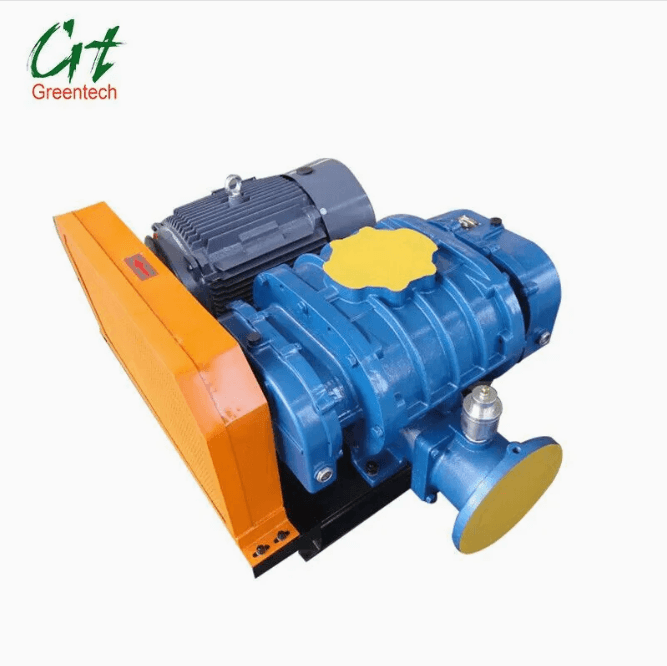
Roots Blower Product Information
Web: http://www.greentechblower.com (Group Web) ‖ http://www.zqblower.cn (Chinese) ‖ http://www.ringblower.cn/ (Ring blower) ‖ http://www.china-blower.com (Roots Blower) ‖ https://www.zibovacuumpump.com (Vacuum Pump)